

Andre
-
goal setting
-
July 1
Horizon Planning
I am writing this not only to share, but also as personal documentation.
There was a period in my career where I was making meaningful progress across nearly every area of my life. At the time, I couldn’t have explained why.
Looking back, I believe many of the ideas in Horizon Planning were already present. I simply didn’t have a name for them yet.
This document is my attempt to understand those ideas, refine them, and use them intentionally moving forward.
At a high level, Horizon Planning starts with responsibilities, skills, and relationships, then allows goals, objectives, projects, actions, and routines to emerge from that reflection.
Introduction
Why I Needed a Different Approach
Building Aeriform
I was building something that realistically could not compete with the myriad of tools already on the market.
Looking back, I was trying to reinvent the wheel.
At one point, I almost quit.
Then I became frustrated with a problem I was solving every week. An idea emerged.
I knew there was a market because I had been paying attention. In fact, I had already purchased several tools that solved part of the problem, but none of them solved it the way I wanted.
Losing Sight of the Vision
At the same time, client work was inconsistent and draining.
I enjoy helping clients and building solutions for others, but at my core I want to be writing code and creating things for myself.
I never envisioned client work becoming the majority of my focus, and I was slowly losing sight of what I wanted Aeriform to become.
Looking for a Way Forward
A few years ago, my wife and I decided to make our Christmas gifts.
Because she loves paper planners, I designed a set of planner inserts for her.
While working on them, I started asking a simple question:
How do I actually get big things done?
I began reflecting on my most successful year in business.
The answer did not arrive all at once, but this was the beginning of Horizon Planning.
The Insight
When I looked back at the most successful periods of my life and business, I noticed something surprising.
I wasn’t obsessing over goals.
I wasn’t constantly switching tools.
I wasn’t trying to optimize a productivity system.
Instead, I was focused on a handful of responsibilities.
I was intentionally building skills.
I was strengthening important relationships.
The goals emerged naturally from those things.
At the time, I was a restaurant manager with a strong salary, the potential for a five-figure bonus, and stock options. Our family had grown, and buying a house became a real priority.
Promotion had moved to the background because my responsibilities had become clearer. What mattered most was providing for my family and being present with them.
That shift changed how I looked at work.
My work goals were largely tied to profitability, but instead of treating them as vague annual targets, I looked at them across the year. I broke each metric into 90-day objectives. Once those objectives were reached, I created maintenance actions to preserve the results.
The same thing happened in my personal life.
I stripped away distractions and focused on what mattered most. I was not just finding time for important things. I was actually accomplishing them.
That period felt different. I was in a groove I couldn’t explain, and it felt like I couldn’t miss.
Looking back, I can see the pattern more clearly.
Responsibilities gave me direction.
Objectives gave me focus.
Actions created progress.
Maintenance preserved the results.
That realization became the foundation of Horizon Planning.
One lesson stayed with me throughout my career.
I rarely tried to improve everything at once.
Whether I was managing a restaurant, coaching clients, or building software, I found that focusing sustained attention on just a few high-impact opportunities produced better results than spreading my attention across everything.
As those systems improved, many of the other results improved with them.
Horizon Planning follows the same principle.
The Problem with Traditional Goal Setting
Rigid Expectations
Many people treat goals as if they have fixed starting and ending points.
January 1 becomes both the beginning and the deadline.
For me, that has never made much sense.
Goals do not need permission from a calendar.
Progress can begin at any time.
The Problem with Resolutions
I eventually realized that I was unconsciously treating January 1 as both a starting point and an ending point.
When I failed to reach a goal by a certain date, I often treated the goal itself as a failure.
Everything Doesn’t Have to Be SMART
Clear goals are important.
However, not everything needs to fit neatly into the SMART framework.
What matters most is having a clear picture of what success looks like.
Living from the Outside In
It is very easy to become reactive.
Email, notifications, deadlines, and urgent requests constantly compete for our attention.
The next immediate thing often wins.
Long-term priorities lose.
Without a system for thinking about what matters most, we slowly drift toward whatever demands our attention today.
What Is Horizon Planning?
Horizon Planning is a framework for connecting long-term vision with daily action.
Most planning systems begin with tasks.
Some begin with goals.
Horizon Planning begins with life.
Over the years I discovered that the most important decisions I made were rarely driven by a task list. They were driven by responsibilities I wanted to fulfill, skills I wanted to develop, and relationships I wanted to build.
Those areas became the foundation of the framework.
Responsibilities reveal obligations and opportunities.
Skills create future possibilities.
Relationships shape nearly every aspect of our lives.
When we intentionally examine those areas, goals begin to emerge naturally.
Goals reveal objectives.
Objectives reveal projects and actions.
Repeated actions become routines.
Over time, those routines shape the direction of our lives.
Horizon Planning is not a productivity system.
It is a framework for intentionally designing the future you want to create.
Due By, Due On, and Do On
One of the most important distinctions in Horizon Planning is the difference between “due by,” “due on,” and “do on.”
Some commitments have a true deadline. These are due by a specific date.
Examples:
- Submit tax return
- Renew driver’s license
- Pay property taxes
- Deliver a client project
Other commitments simply require attention and progress. These are due on a recurring basis.
Examples:
- Work on a writing project
- Review finances
- Spend time with family
- Plan the next quarter
- Learn a new skill
Treating everything like a deadline creates unnecessary pressure.
I rarely use fake deadlines. They create too much friction.
When I build plans, I only assign a deadline when there is a real reason for one. Otherwise, I focus on rhythm, attention, and progress.
“Do on” is different. It describes the day you intentionally choose to work on something. A task may be due by Friday, but I may decide to do it on Tuesday.
That distinction belongs more to execution than planning, so I will return to it in the next article.
Recognizing the difference helps create a more sustainable planning system.
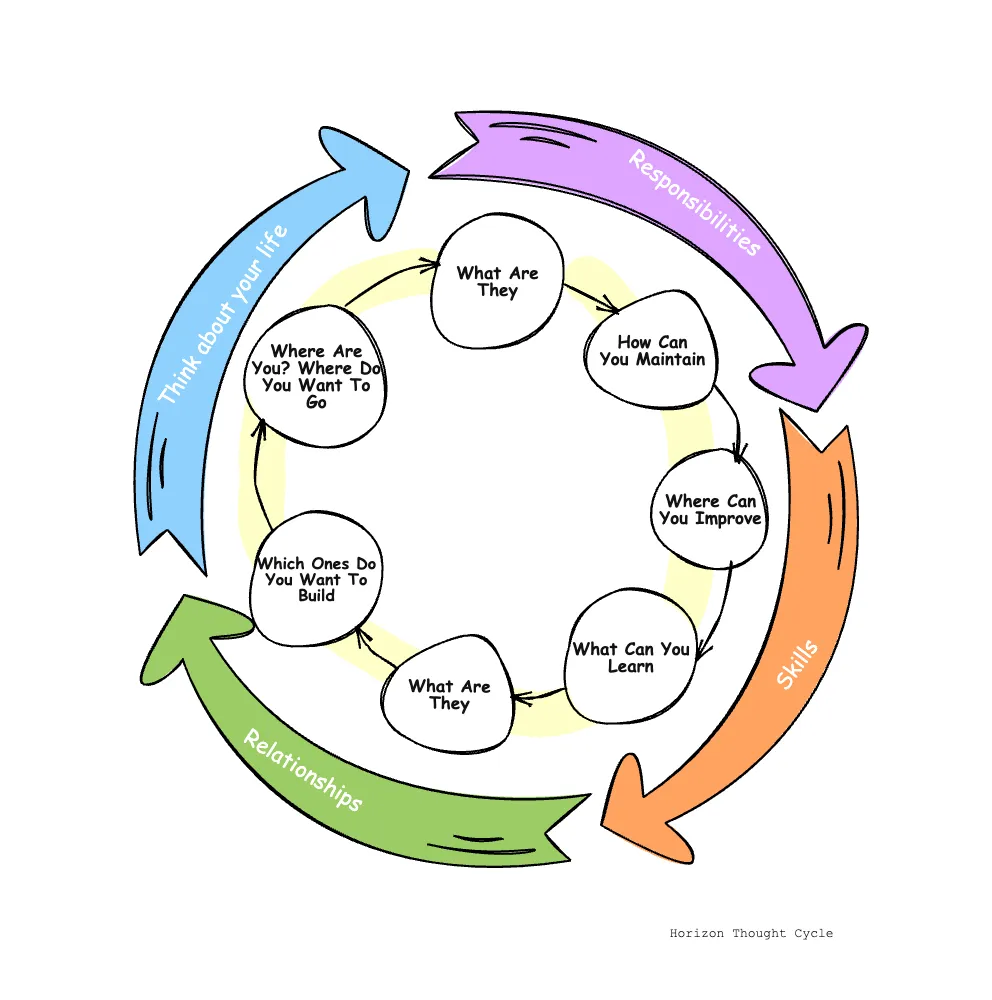
Conducting a Horizon Review
Before creating goals, objectives, projects, or actions, I begin with a Horizon Review.
The purpose is simple:
- Understand where I am today.
- Identify where I want to go.
- Discover opportunities for growth.
I do this by asking questions about responsibilities, skills, and relationships.
Responsibilities
What are you currently responsible for?
Examples:
- Finances
- Health
- Family
- Home
- Career
What responsibilities would you like to have in the future?
Examples:
- Department Manager
- Business Owner
- Homeowner
- Community Leader
For each responsibility, ask:
- What can I do to maintain my current results?
- What can I do to improve my current results?
- What can I do to earn or prepare for future responsibilities?
Example:
Current Responsibility
- Finances

Maintain
- Continue following a monthly budget

Improve
- Reduce credit card debt

Future Responsibility
- Business Owner

Prepare
- Launch a software product
- Learn business finance
Skills
What skills would you like to improve?
Examples:
- Public speaking
- Writing
- Spanish
- Leadership
What would you like to learn?
Examples:
- Piano
- Photography
- Swift Development
- Graphic Design
How will you know you have improved?
Examples:
- Speak comfortably with Spanish-speaking relatives
- Deliver presentations with confidence
- Play a complete song on the piano
Relationships
What relationships are important to you today?
Examples:
- Spouse
- Children
- Friends
- Colleagues
What relationships would you like to strengthen?
Examples:
- Spend more intentional time with family
- Reconnect with old friends
- Become a better mentor
What relationships would you like to build?
Examples:
- Local business owners
- Professional peers
- Community leaders
For each relationship, ask:
- What would maintaining this relationship look like?
- What would improving this relationship look like?
- What actions could I take to build new relationships?
Example:
Current Relationship
- Husband

Maintain
- Weekly date night

Improve
- Say yes more often to activities important to my wife

New Relationship
- Community Leaders

Build
- Attend town council meetings
- Volunteer locally
The goal is not to create a perfect plan.
The goal is to discover what matters.
As patterns emerge, goals begin to reveal themselves.
From there, objectives, projects, actions, and routines become much easier to identify.
The answers from a Horizon Review become the raw ingredients for planning.
To help you get started, I’ve included a downloadable Horizon Review Worksheet containing the questions from this section along with space to write your answers.
The Horizon Review helps you discover what matters. As ideas become more important or require additional thought, flesh them out in a Goal, Objective, or Project Planning document.
From Reflection to Action
The answers to these questions begin to reveal your goals.
Goals, Objectives, Projects, Actions, and Routines
I often compare planning to baking a cake.
Most people don’t begin by gathering random ingredients and hoping a cake appears.
They begin with a picture of the finished cake in mind.
Once they know what they’re trying to make, they begin identifying the major components. The cake needs layers. It needs frosting. It needs decorations.
As they continue planning, the details emerge naturally.
Ingredients become shopping lists.
Preparation becomes a series of steps.
They don’t begin with structure.
They discover it.
Planning works the same way.
We begin with an outcome and work backward from there.
When planning, I do not start by asking whether something is a goal, objective, project, or task.
I start with a simple outline.
I write down a goal and begin listing everything that I believe will help me achieve it.
As the outline grows, patterns begin to emerge.
Some items become objectives.
Some become projects.
Others remain simple actions.
As actions are repeated, routines begin to emerge.
The structure is discovered, not imposed.
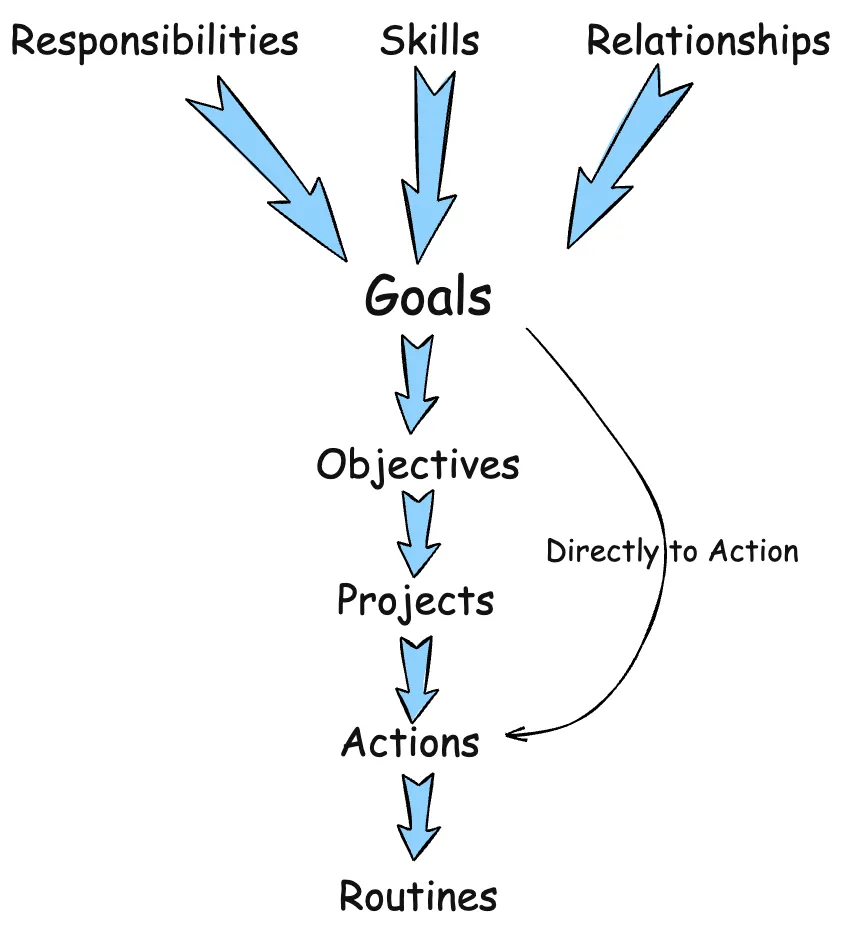
Goals emerge from reflection. Objectives and projects provide structure when needed. Actions create progress. Repeated actions become routines.
Horizon Planning is less about categorizing your work and more about understanding what matters.
For example:
Goal: Purchase a Home

- Purchase a home in the Five Points neighborhood
    - Work with a realtor
        - Call Coldwell Banker
        - Schedule an introductory meeting
        - Create a list of desired neighborhoods and home features

- Save a 20% down payment and keep monthly payments affordable
    - Review household budget and identify $800 per month in savings
    - Improve credit score
    - Increase emergency fund savings
    - Compare mortgage options

- Attend an open house this weekend

- Ask Sam and Jane about their recent home-buying experience
After stepping back, we can identify the different pieces.
Goal
A goal is a meaningful outcome you want to achieve.
Goal
- Purchase a home
Objectives
Objectives are the major areas of focus that move a goal forward.
Objectives
- Purchase a home in the Five Points neighborhood
- Save a 20% down payment and keep monthly payments affordable
Projects
Projects are created when an objective requires coordinated effort over time.
Project
- Work with a realtor
Actions
Actions are the individual steps that move a goal, objective, project, or responsibility forward.
Notice that not every objective contains a project.
Likewise, not every action belongs to a project.
Some actions support a project.
Some support an objective directly.
Others support the goal itself.
The purpose of Horizon Planning is not to force everything into a rigid structure.
The purpose is to provide enough structure to make meaningful progress.
Routines
Many planning systems focus almost entirely on projects.
Projects are important because they create change.
A project can help you lose weight, launch a business, pay off debt, or buy a home.
The problem is that projects eventually end.
If nothing replaces them, the results often disappear.
This is why routines are so important.
A project may help you lose twenty pounds.
A routine helps you keep it off.
A project may help you save a down payment.
A routine helps you build long-term financial stability.
A project may help you launch a business.
A routine helps you continue operating and improving it.
Many of the most important areas of life eventually move from project mode into maintenance mode.
The goal is not to spend your entire life chasing projects.
The goal is to create routines that support the life you want to build.
Let Ideas Grow
One of the biggest mistakes I made when planning was creating too much structure too early.
Not every thought needs its own project.
Not every goal needs a detailed plan.
Not every action needs a category.
Everything starts small.
A responsibility may begin as a single bullet point in a Horizon document.
A goal may begin as a simple idea.
An objective may begin as a note beneath a goal.
As ideas become more important, they earn additional structure.
When something requires more attention, create a dedicated document.
When a body of work requires planning and coordination, it becomes a project.
The framework grows with your needs rather than forcing you to create structure before it is necessary.
The structure is discovered, not imposed.
Organizing the Framework
The framework is tool agnostic, but it helps to have a simple way to organize the pieces.
My current structure looks something like this:
Planning
├── Horizon
├── Goals
├── Objectives
└── Projects
The Horizon section is where the thinking begins.
This is where I keep notes about responsibilities, skills, relationships, future responsibilities, and opportunities. Most of these begin as simple bullets. They do not need to be fully formed ideas.
A bullet may eventually become a goal.
A goal may develop objectives.
An objective may require a project.
A project may produce actions.
For example:
Horizon
└── Future Responsibility: Homeowner

Goals
└── Purchase a Home

Objectives
├── Save a 20% Down Payment
└── Purchase in Five Points

Projects
└── Work With a Realtor
In practice, my Horizon document often starts with nothing more than a list of thoughts and questions.
Responsibilities
├── Home
├── Finances
├── Health
└── Business

Future Responsibilities
├── Homeowner
└── Software Business Owner

Skills
├── Swift Development
├── Writing
└── Product Design

Relationships
├── Family
├── Friends
└── Professional Network
Over time, some of these ideas become more important.
When they do, I create a dedicated goal, objective, or project document and continue developing them there.
This allows ideas to grow naturally without forcing structure too early.
One of the reasons this works so well for me is that Horizon Planning is designed to be lightweight. The framework provides direction without requiring extensive maintenance.
The documents are not the system.
The thinking process is the system.
The documents simply support it.
This is why Horizon Planning can work in UpNote, Apple Notes, Obsidian, OneNote, a Franklin Covey planner, a notebook, or even a sheet of paper.
The tool only needs to provide enough structure for your ideas to grow.
From Long-Term Thinking to Short-Term Focus
A Horizon Review often reveals dozens of worthwhile ideas. The challenge isn’t deciding what matters. It’s deciding what deserves your attention right now.
Every ninety days I choose a small number of responsibilities, objectives, and projects that deserve focused attention.
I’ll explain that process in the next article: Horizon Execution.
Tools That Can Help
The System Should Be Tool Agnostic
Horizon Planning is a framework, not an application.
It should work regardless of the tools you choose.
The goal is to spend more time thinking and doing, and less time managing software.
Three Core Components
Most people already have everything they need.
Notes
Examples include:
- UpNote
- Apple Notes
- OneNote
- Obsidian
Calendar
A calendar provides awareness of commitments and available time.
Tasks
A task manager provides visibility into actions and projects.
Paper Works Too
The framework can be implemented with:
- A planner
- A notebook
- Index cards
- A sheet of paper
The tool is less important than the process. That moment of zen earlier in my life was managed by a Franklin Covey paper planner (I even shelved my Palm V for a while).
Subscription Fatigue
There are some incredible productivity tools available today.
Many offer powerful features and solve real problems.
However, I often find myself asking:
Who are these tools really for?
Many seem to hide the fundamentals behind increasing complexity.
If a service has real operating costs, I understand the need for subscriptions.
But Horizon Planning should not require a collection of expensive tools to be effective.
The framework should work with the tools you already own.
I Can See Clearly Now…
I didn’t need a better task manager.
I didn’t need a more complicated productivity system.
I needed a way to connect my daily actions to the life I wanted to build.
Horizon Planning became that bridge.
It begins with understanding your responsibilities, skills, and relationships.
Those areas reveal goals.
Goals reveal objectives.
Objectives create projects and actions.
Actions become routines.
Over time, those routines shape the direction of your life.
The structure is discovered, not imposed.
Of course, understanding what matters is only half of the equation.
Goals do not accomplish themselves.
Objectives do not move forward on their own.
Eventually, ideas must become action.
In the next article, I’ll explore Horizon Execution: how I use this framework in practice to consistently move projects, routines, and responsibilities forward.