

Andre
-
accounting software
-
May 18
How I Modernized GnuCash Workflow Without Leaving GnuCash
For the last few years I have bounced between various personal finance applications.
Some were excellent budgeting tools. Others were excellent accounting systems.
What I struggled to find was a solution that combined the visibility of modern budgeting software with the accuracy and flexibility of double-entry accounting.
Eventually I stopped looking and decided to build it myself inside GnuCash.
Why I Wanted More From GnuCash
I am a big believer in double-entry accounting. Whether you are managing a business or your household finances, having a complete and accurate picture of your money matters.
GnuCash provides exactly that. It is a powerful accounting system with reporting capabilities that rival software costing significantly more.
The challenge is that GnuCash was designed first as an accounting application. While the reports are excellent, getting a quick answer to everyday questions often requires jumping between multiple reports and screens. The information is there, but it is not always easy to glance at.
That is not necessarily a criticism. Accounting software records financial activity accurately. It is not always designed to answer personal finance questions at a glance.
Personal Finance Is Different
For business accounting, that is usually not a problem.
My business books primarily answer questions like:
- Are the books balanced?
- What was my revenue?
- What were my expenses?
- What does the profit-and-loss statement show?
Personal finances are different.
The questions I ask every week are things like:
- How much money do we have available right now?
- Are we staying within our budget?
- How are our sinking funds progressing?
- What bills are coming up?
- How is debt repayment going?
- What will our account balances look like at the end of the month?
Personal finances are just that: personal. The questions are like those of a business, but the answers often need to be presented differently. The tools people use to manage their finances are generally shaped differently than business applications.
Several of the tools I have used in the past are excellent budgeting applications, but they are not accounting systems. I wanted the visibility of a budgeting tool without giving up the structure and accuracy of double-entry accounting.
If I am reviewing my business books, I care about profitability, expenses, and whether everything reconciles correctly.
If I am reviewing my household finances, I care about things like:
- Can we afford to replace the water heater if it dies next month?
- How much money is available for Christmas?
- Are we still on track to pay off a debt by the end of the year?
- Did we overspend on dining out this month?
The information existed inside GnuCash. It just was not presented in a way that made those answers immediately obvious.
Why I Stayed Inside GnuCash
The answers already existed inside GnuCash, but they were spread across multiple reports.
One solution would have been to build a separate application or create a server-based dashboard.
I considered both.
The problem is that every additional application creates more complexity. Another database. Another deployment. Another backup strategy. Another thing to maintain.
I have built enough software over the years to know that what starts as a small project often becomes something that requires ongoing maintenance. Updates. Bug fixes. Documentation. Support.
Meanwhile, GnuCash already contained all of the data I needed.
So my decision was fairly simple.
One of my primary goals was to take advantage of the reporting capabilities that already existed instead of creating an entirely separate system.
Why I Built Reports Instead of Another Application
Once I decided to stay inside GnuCash, the path became much clearer.
Rather than creating a new budgeting application, I focused on building reports that answered the questions I actually ask myself during my weekly financial review.
The result became Financial Radar.
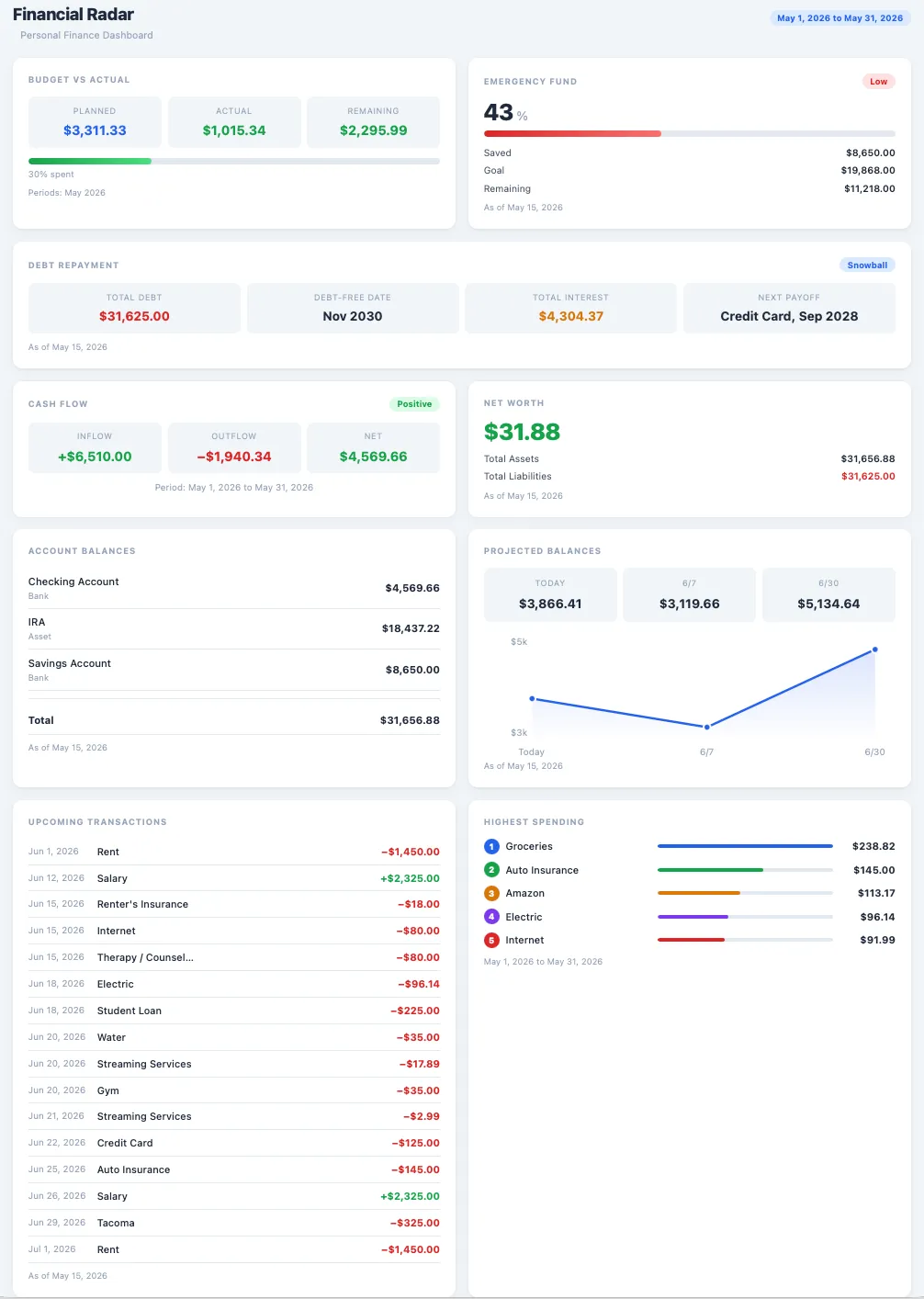
What started as a dashboard eventually expanded into a collection of reports covering budgeting, debt repayment, projected balances, scheduled transactions, and long-term planning.
Instead of replacing GnuCash, the reports sit on top of the existing accounting data and provide a more consolidated view of what is already there.
How Financial Radar Fits My Weekly Routine
My financial routine is intentionally simple.
Every Monday, Wednesday, and Friday, I import transactions, reconcile accounts, review upcoming bills, and make any adjustments that are needed. It is the same routine I have written about elsewhere because it keeps me engaged with my finances without consuming my entire week.
Most weeks, the entire process takes less than thirty minutes.
The goal is not to spend hours managing money.
The goal is to understand what is happening and move on with life.
Financial Radar gives me a dashboard-style view that lets me review budget progress, cash flow, debt payoff progress, upcoming transactions, projected balances, and overall financial health from a single location.
Instead of bouncing between multiple reports, I can quickly identify anything that needs attention and continue with my day.
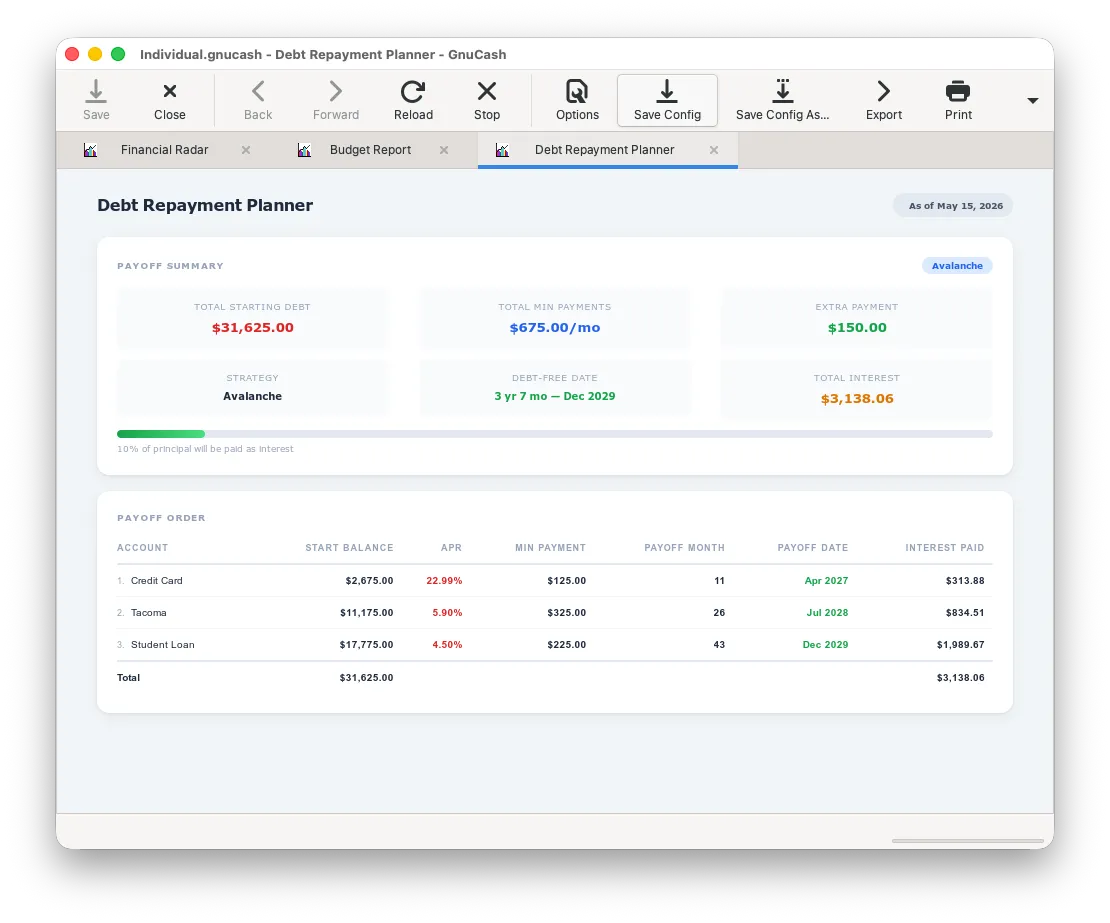
Sinking Funds and Future Purchases
One of the biggest changes to my workflow was adopting sinking funds and what I call Future Purchases.
I did not invent the concept. In fact, I learned it years ago while saving for my first Super Nintendo. Long before I had heard terms like sinking funds, I was setting aside money for something I knew I wanted to buy.
Today the concept appears in many budgeting applications, but the underlying idea remains the same.
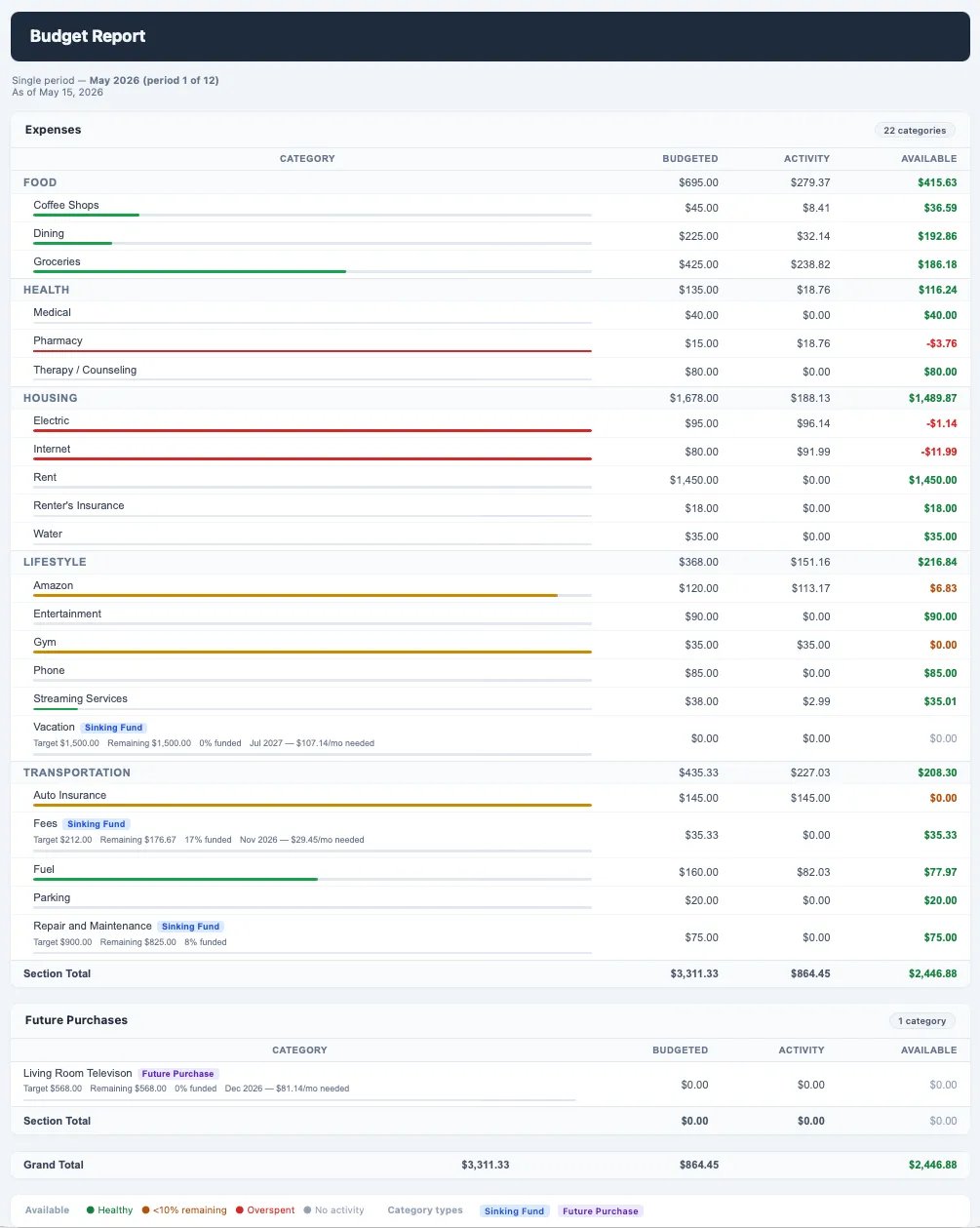
Rather than treating every expense as something that appears unexpectedly, I can gradually set aside money for known future needs.
Car repairs.
Home maintenance.
Vacations.
Technology purchases.
Before adopting this approach, many of these expenses felt like emergencies.
The reality is that most of them were completely predictable.
I knew the roof would eventually need repairs. I knew the car would eventually need maintenance. I knew Christmas was coming.
The challenge was not predicting the expense. The challenge was preparing for it.
The modified budget report allows these categories to accumulate over time while still remaining inside GnuCash’s budgeting framework.
More importantly, it allows me to see those future obligations alongside everything else I am managing.
That visibility makes planning much easier and reduces surprises.
The Result
Financial Radar did not replace GnuCash.
It simply made GnuCash easier for me to use.
The accounting remains the same. The underlying data remains the same. The reports provide a more modern view of information that already existed inside the book.
For me, it became the bridge between traditional accounting and modern budgeting.
If you would like to try the reports yourself, the project is available on GitHub.